Frequently Asked Questions
Straight answers to the questions we hear most often — from homeowners planning a loft upgrade, architects spec'ing SF40 into a solid-wall refurb, and main contractors weighing up multi-layer foil against traditional PIR. If your question isn't here, ring us — we'd rather have a proper conversation than leave you guessing.

What is Superfoil insulation?
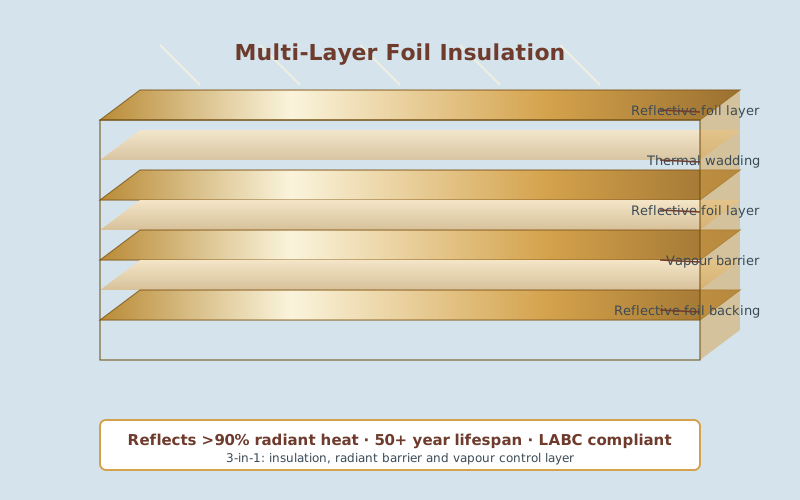
SuperFOIL is a multi-layer foil insulation that combines reflective aluminium foil barriers with insulating thermo-foam and wadding layers in a single thin, flexible roll. It acts as a 3-in-1 product: a thermal insulator that slows conductive heat loss, a radiant barrier that reflects radiant heat, and a vapour control layer that stops warm, moist air from migrating into the roof structure. The two most common products in the range are SF19+ (an 11-layer composite) and SF40 (a 37-layer premium product). There are also non-combustible (SFNC), thermal-vapour (SFTV) and bubble-foil (SFBA) variants for specific applications.
How is Superfoil different from PIR board or mineral wool?
Traditional insulants work by trapping still air — PIR does it inside a closed-cell foam, mineral wool inside a matrix of glass or rock fibre. Both rely on slowing conductive heat transfer. Multi-layer foil does that too, but adds a third mechanism: it reflects radiant heat back before it can conduct through the assembly. Because radiant heat is a huge component of summer gains and night-time losses, adding reflection lets a much thinner build-up match the U-value of a thicker conventional insulation. That matters enormously in retrofits where every millimetre of rafter depth is precious, and in solid-wall upgrades where internal insulation steals floor area.
Does Superfoil need an air gap?
Yes, and this is the single most common mistake made by non-specialist installers. For the reflective foil layers to actually reflect, there must be a continuous air gap on at least one side of the product — ideally both. SF19+ and SF40 are typically specified with a 25mm air gap above and below when fitted between rafters. Staple the foil tight to the rafter edge with no air gap and the reflective layers become conductive: you'll still measure some thermal resistance, but you'll lose most of what you paid for. Our installs always include the counter-battens and spacers needed to preserve the gaps.
Will Superfoil meet UK Building Regulations?
Yes — provided it's fitted to specification and the right product is chosen for the element. For a pitched roof, SF40 on its own can hit current U-value targets; for a solid wall, SuperFOIL publishes a build-up using 70mm total depth that clears current Part L requirements, which is remarkable for such a shallow assembly. For new-build and notifiable refurbishments we provide full U-value calculations using SAP methodology and hand over LABC-compliant paperwork. On Competent Roofer schemes, certain works can be self-certified without a separate LABC visit.
How much does a Superfoil roof install cost?
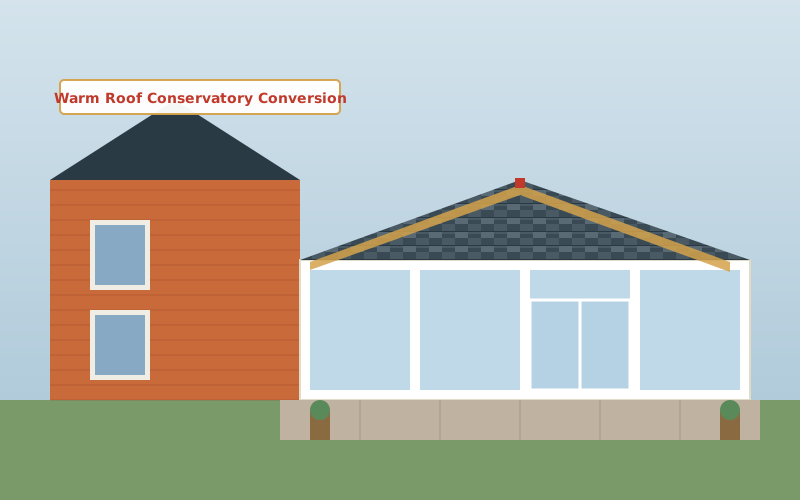
Pricing depends on the roof size, access, what's already up there, and which product is specified. As a rough guide for retrofit work: between-rafters SF19+ on a typical 3-bed semi loft usually lands in the £1,800–£3,500 range including materials, labour, SuperFOIL-approved tape, and counter-battens. Full warm-roof conservatory conversions using SF40 sit in the £4,500–£8,500 range depending on the roof structure. Commercial and new-build pricing is done per square metre; please ring for current rates. Every quote we issue is free, written, itemised, and fixed for 60 days.
How long does a typical install take?
Between-rafters retrofit on a standard UK loft runs 1–2 days for a 2-bed, 2–3 days for a 3 or 4-bed. Full warm-roof conservatory conversions usually take 3–5 days including the replacement insulated panels and the finishing internal plasterboard. New-build under-rafter installs are paced to the main contractor's programme — typically 1 day per 80–100 square metres with two installers. We always give you a day-by-day schedule with the quote so you know exactly what's happening when.
Is Superfoil safe? Is it fire-rated?
Yes. Standard SF19+ and SF40 carry Euroclass fire ratings suitable for most domestic use. For fire-sensitive applications — flats above certain heights, commercial buildings with specific fire strategies, escape routes, buildings requiring A1/A2 classification — we specify SFNC, the non-combustible variant, which carries a Euroclass A2 rating. Part of our survey is confirming which product is appropriate for your specific application; you won't get the wrong one just because it was cheaper.
Will it cause condensation?
Only if it's fitted wrong. Foil insulation includes a built-in vapour control layer, which is precisely what you want on the warm side of the insulation — it stops warm, moist air from the living space migrating into the cold side of the roof structure where it would condense. Problems arise when the VCL is punctured by services passing through without sealing, when laps between rolls aren't sealed with approved tape, or when cold-side roof ventilation is blocked by the insulation being pushed up to the eaves. Our installs always preserve the ventilation path — over-fascia vents, tile vents, or ridge vents as appropriate — and seal every lap with SuperFOIL-approved foil tape. This is non-negotiable on every job.
Can I fit Superfoil myself?
Technically yes, and plenty of competent DIYers do. Realistically, the product only pays back its cost if the air gaps, laps and vapour control are correct — and those are the things that routinely get missed on DIY installs. If the job is regulated under Building Regs (new build, extension, conversion of unheated space to heated), LABC will want to see either a competent-person certificate or inspection evidence, both of which are harder to satisfy on a self-install. Our honest advice: if the foil is the only significant element of a small DIY job you've already planned, fitting it yourself is fine. If you're doing the whole roof upgrade in one go, have it fitted.
How long does Superfoil last?
The aluminium-coated PET foils and thermo-foam layers have a rated functional lifespan of 50+ years — longer than most roof coverings and significantly longer than most mineral wool, which tends to slump and degrade in condensing environments. In practice, the roof above it will need stripping and re-covering long before the foil needs replacing. That's a useful point to remember when comparing a lifetime cost-per-year against cheaper but shorter-lived alternatives.
Does it affect Wi-Fi or mobile signal?
Foil insulation will attenuate radio signal passing through the insulated plane — that's just physics — but it does not block it entirely, and crucially it does not affect signal propagating within the rooms below the roof. In practice, Wi-Fi routers placed in living spaces (where they belong) continue to work exactly as before. Mobile signal reception is not noticeably affected unless you were already in a marginal coverage area with a signal arriving directly through the loft. We've fitted foil in thousands of homes and haven't had a connectivity complaint yet.
What's the warranty?
Every install carries two warranties stacked on top of each other: the manufacturer's product guarantee (50-year functional lifespan on the SuperFOIL materials) and our own 10-year workmanship warranty on the install itself. You get both in writing at handover, along with product datasheets, photographs of the critical stages, and — where applicable — LABC compliance notes or Competent Roofer certificates. Keep the pack with your house papers; it matters when you sell.
Do you work outside your main service area?
For domestic retrofits we mostly stay within the North West, Yorkshire, the East and West Midlands, and Lincolnshire. For larger commercial contracts or new-build sites with several hundred square metres of foil we'll travel further — a quick phone call will confirm whether the numbers work. We never add hidden mileage: if travel adds a cost, it's itemised on the quote so you can see it.
Still have a question?
We'd rather answer you properly than leave you guessing. Call the number below, drop us an email, or book a free survey.